

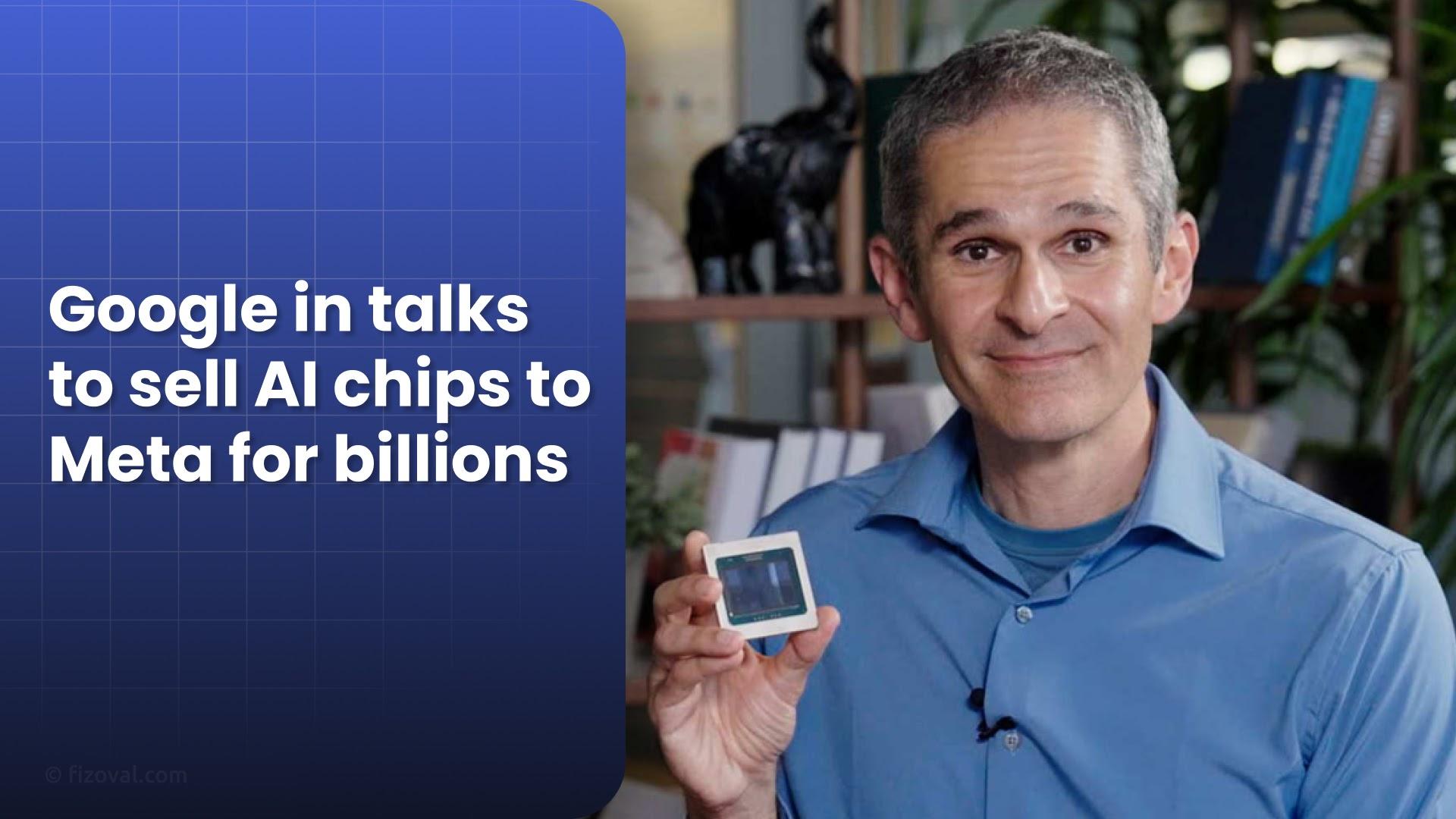
"Meta is in advanced talks to adopt Google TPUs, marking a major shift in the AI chip market and a potential challenge to Nvidia’s long-standing dominance."
The AI chip race is heating up again. Meta is now in advanced discussions with Google to bring Google’s tensor processing units (TPUs) into Meta data centers starting around 2027. The social media giant is also exploring the option of renting TPU compute power from Google Cloud as early as 2026. If the deal materializes, it could be one of the biggest disruptions in the AI infrastructure market in years.
Why is this such a big deal?
Until now, Meta has heavily depended on Nvidia GPUs to power its AI workloads—from training Llama models to powering feed ranking, recommendations, and ads across Facebook, Instagram, WhatsApp, and Reality Labs. Adding Google TPUs introduces a second supplier and gives Meta more pricing leverage and guaranteed compute availability in a highly supply-constrained market.
How is Google shifting its strategy?
Google TPUs were long available only as a cloud service inside Google Cloud data centers. But the company is now pitching TPUs for deployment directly inside customer facilities. This means Google is stepping directly into Nvidia’s strongest territory: on-prem AI compute for hyperscalers.
| Vendor | AI Hardware Focus | Deployment Style |
|---|---|---|
| Nvidia | GPUs (H100, H200, Blackwell) | Cloud + on-prem |
| TPUs (Ironwood, etc.) | Cloud + on-prem (new strategy) | |
| Meta | AI systems buyer | Hyperscale internal infrastructure |
What does Meta get out of the deal?
- Reduced dependency on Nvidia
- Better leverage on long-term chip pricing
- More certainty about compute supply for training and inference
- A mix of GPU + TPU architectures for flexible AI scaling
When you’re spending billions every year on AI hardware, even single-digit price efficiencies turn into massive savings.
Where do Google TPUs stand today?
Google spent nearly a decade developing its TPU lineup and is now on its seventh-generation architecture (Ironwood). Ironwood is optimized for massive inference workloads such as large-scale LLM serving and mixtures-of-experts (MoE) systems. It supports clusters of thousands of TPU cores in a single superpod—perfect for Meta-level scale.
Does this put pressure on Nvidia?
Absolutely. Nvidia still dominates with Hopper and Blackwell, but if a hyperscaler like Meta commits billions to TPUs, even a small percentage shift in spend turns into a major redirection of the datacenter market. Nvidia’s valuation depends on its ability to keep hyperscalers locked into its platform. A diversified AI chip ecosystem is a real threat.
Who else is using TPUs?
Meta wouldn’t be the first big customer. Anthropic signed a deal to access up to one million TPUs, citing strong price-performance benefits. Google is also pitching TPUs to financial institutions and high-frequency trading firms that need both high performance and sensitive data control.
What does this mean for AI infrastructure in 2026–2030?
Enterprises and AI startups may soon need to choose between—or combine—multiple AI compute ecosystems. Google’s move also shows that the AI chip market won’t stay a one-vendor world much longer. Big buyers want multi-chip strategies, and Google is positioning itself to be the first true alternative to Nvidia.
Meta considering TPUs isn’t just a business rumor—it signals the beginning of the AI hardware multi-vendor era.
FAQs
Are TPUs faster than GPUs?
It depends on the workload. TPUs are extremely efficient for large-scale LLM inference and recommendation systems, while GPUs are still dominant in training flexibility.
Will Meta fully replace Nvidia GPUs?
No. This move looks more like diversification rather than replacement. A hybrid TPU + GPU architecture gives Meta more control and predictability.
Can businesses outside hyperscalers use TPUs?
Yes. Google is now offering TPUs via cloud and on-prem deals to startups, finance companies, and other enterprises—not just AI labs.


